| TECH Project. | |||||||||||
 The Role of the Sail
| |||||||||||
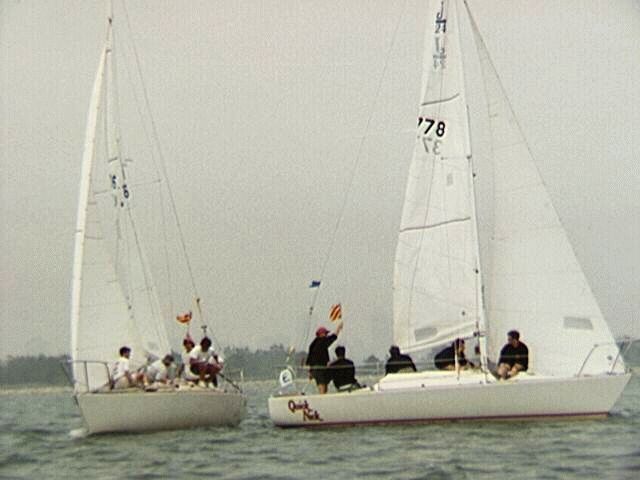
| The Sail is probably the most important object aboard a sailboat (hence the name). Sails and airplanes wings are very similar. Both are airfoils and operate in much the same way. The air flowing past a sails curved surface is diverted form a straight line path. This curve causes the air to react differently on each side of the sail. Over the side which the wind is striking (Windward) side, the air slows down and a high pressure area starts to develop. At the same time, air flowing over the bulging opposite (leeward) side begins to speed up and its pressure falls. As this high pressure/low pressure system becomes more established a greater amount of the approaching air is sucked towards the low pressure (leeward) side of the sail (and deflected away from the high pressure windward surface). The extra air passing to leeward results in still greater flow speeds and even lower pressures on the leeward side of the sail. This difference of pressures on opposite sides of the sail produces a useful force much in the same way that blowing into a loaded pea shooter creates a pressure difference of opposite sides of the sail. In the case of a pea shooter this pressure shots the pea. In the case of the sail, the force that is created is transferred down through the rigging to push the hull of the boat through the water. | ||||||||||
|
|
A sail is not truly flat. It contains curves, these curves are called draft. The draft of the sail is very important as it effects the amount of power the sail produces. When the wind is gentle and you want as much power as possible from your sails the curvature or draft should be increased. This can be done be decreasing the distance between the two bottom corners of the sail. If the wind is too strong and your boat is overpowered you will want to decrease the draft by making the sail flatter (increasing the distance between the two bottom corners.) The flatter sail allows more air to spill of the sail while a sail with a large draft allows the sail to catch all the air and therefor have more power.
If you wish to travel up wind you must also decrease the amount of draft in your sails. The flatter the sail the further you are able to point upwind. This is great as long as you can keep your speed up. Flat sail are wrong in rough water as you need the extra power to beak trough the waves. By adding a little extra draft you can not point as high but your speed will increase and you will make better overall progress.

| ||||||||||
|
The sail is angled in the airstream so that the lift it generates drives the boat forward, and for the boat to sail efficiently the sail must be set at the correct angle of attack to the wind. As and aide to setting the sails at the correct angle pairs of tell-tails (usually two pieces of yarn) are attached at regular intervals to both side of the forward part of the sail. If these both fly straight backwards the air flow is correct. If the sail is not angled correctly these tell tales will flutter. If this were a plane, it would stall and fall out of the sky. Fortunately if the sails stall the boat will only lose its forward momentum. This could also be dangerous, if you do not have momentum your steering is also
useless and the boat is in the mercy of the currents.
|
|
|
| 
Email me at:  [email protected]
 | |||||||

|
This page has been visited
|